Loading page content...

Most Frequently Asked Questions
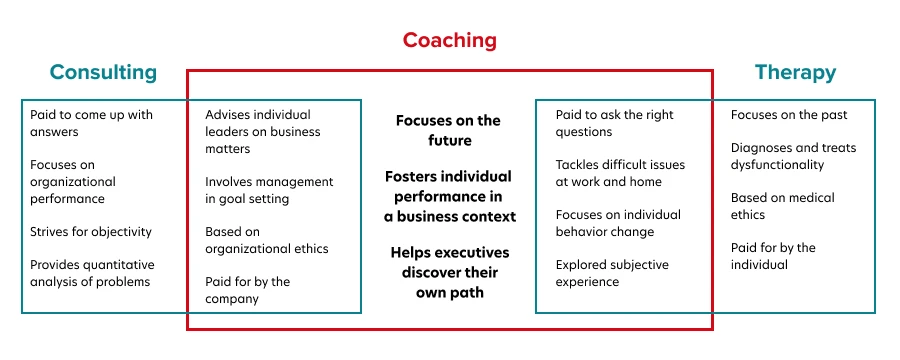
- Coaching is:
 Guided (going fishing together)
- Future focused
- Rooted in assessment of current reality and what is working and what is not
- Developmental (based on a process of change through reflection, planning and practice)
- Therapy (counseling, psychotherapy, psychoanalysis, mental health care or substance abuse treatment) is:
- Investigative (why are you doing things based on childhood or adolescent patterns)
- Focused on the past
- 'Fixing' people or problems
- Leadership Coaching:
- •Ideal for emerging lor first line leaders (Directors and VP's), and people leaders looking to refine their leadership style, build confidence, and effectively guide their teams.
- Executive Coaching:
- •Tailored for senior leaders and C-suite executives aiming to enhance strategic decision-making, navigate complex challenges, and drive organizational success at the highest level.
Business coaching with me is:
1. Understanding reality: Supporting a client to develop clarity about their current personal and organizational reality and define the relationships through which they will succeed
2. Defining Aspiration and Change: Help them articulate what they want to be different - aspirations and goals
3. Planning and Focus: Assist them in building radically focused, (prioritized and sequenced), practical plans of action to achieve their aspirations and goals
4. Practicing: Hold them accountable and give feedback as they practice the new personal, team and organizational behaviors and habits to achieve success
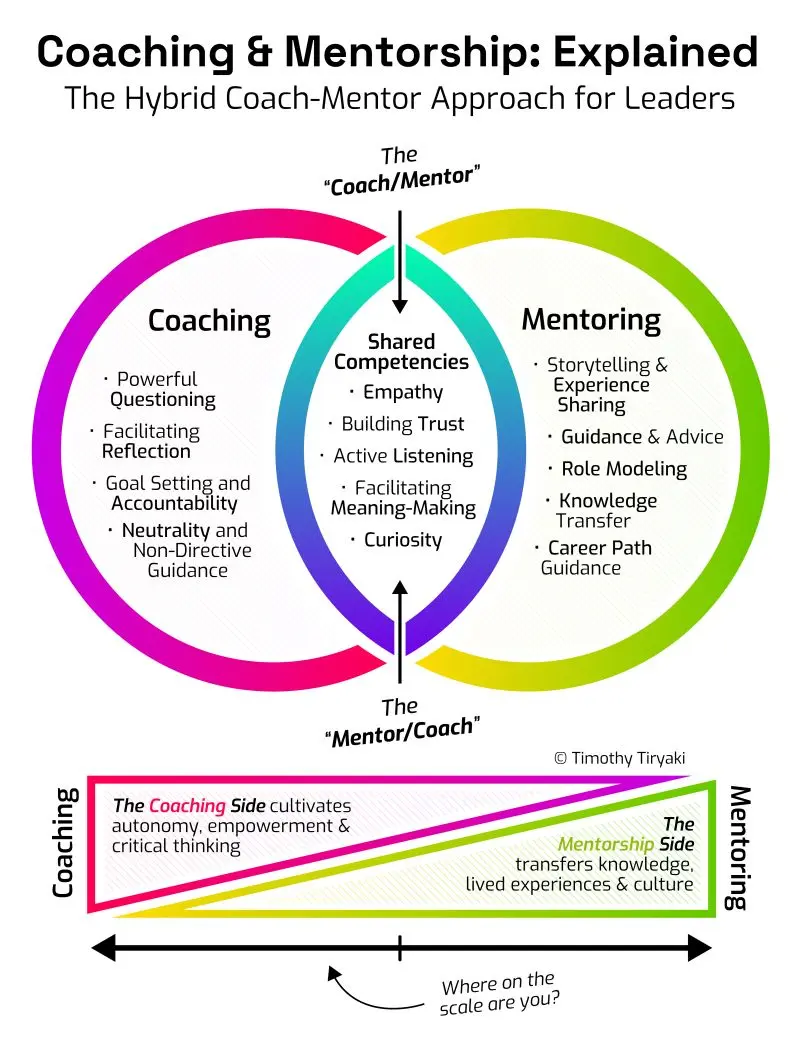
My role as coach is to help you to identify and unlock the obstacles that are preventing you from achieving your maximum potential and help motivate you to create sustainable and transformational change. My role is to ask questions which uncover your potential and make it explicit. Together, we will explore what matters most in your work and life. We then craft a vision / purpose, goals, and a plan to put you on a path to realize your desired future potential. I will create a safe and confidential coaching environment via openness, transparency, and a non-judgmental respectful and positive attitude. Think of me as being your guide through the process. I can do this in three separate modes:
- Coaching: I can offer you a mirror and a tool kit for you to create a problem solving 'sand box' to build your own solutions
- Mentoring: I can offer you the benefit of my experience (where applicable) in relation to your issue or opportunity – what did I do in this set of circumstances or what have I seen work with other clients or colleagues.
- Advising: I can sit in the problem solving 'sand box' with you and co-create a solution - I can help you with a framework for the opportunity or problem solve with you
I will be explicit about which of these I am suggesting and will ask your permission to play that role with you at the time.
- Individual coaching improves leadership performance dramatically over time, including:
- increased self-awareness
- greater clarity about aspirations, goals and motivation
- greater individual leadership presence
- enhanced skills
- better team leadership
- better decision-making abilities
- better relationship building
- enhanced communications
- and greater confidence
- Benefits of team coaching:
- greater clarity about aspirations, goals and motivation
- better teamwork through understanding roles, responsibilities, personalities and needs
- higher motivation and engagement
- increased problem solving, decision making and learning
- overall achievement of business results for the team and organization
Business coaching with me is:
1. Transition / Planning a Transition: How can I successfully navigate a new role, a promotion or career transition / job search, or a life transition (international move, retirement etc.)?
2. Skill / performance improvement: How to be better at a competency (e.g. leadership presence and style, operating model, managing teams, problem solving, conflict management, communications, board management, time and calendar management, giving and receiving feedback etc.)?
3. Work / Life Balance: How to achieve work / life balance? How to find passion and purpose? How to be more mindful and present?
4. Mindset: How to think / feel differently, by discovering and clarifying - motivation, objectives / goals, limiting beliefs and decision making?
5. Crisis: How to deal with a 100-year storm?
6. Mirror / Confidant: Who can I trust to talk to? It's lonely at the top. Having a confidant who is there just for you.
- Individuals who find the most success from coaching have some common character traits, these are humility, honesty, openness, grit (persistence and consistence) and deep curiosity.
- Teams that get the biggest return are open, honest and willing to have tough conversations to improve.
I do not coach individuals or teams under these circumstances:
- The coaching is being used as a “last ditch” effort to save an executive who should really leave the company. Remedial coaching efforts often result in “too little, too late” for an executive who is unlikely to change a consensus already reached or secure forgiveness from key stakeholders.
- Success is driven by factors beyond the executive's or Team's reach, such as economic, technological or other business factors.
- The executive suffers from personal or emotional problems that are best addressed by a professional such as a clinical psychologist, social worker or lawyer.
- The problem emanates from a poorly designed organizational structure or management process, rather than from the individual or Team. These situations may be best addressed by an organizational development specialist.
- The executive is in the wrong job or position. Some situations require reassignment and may call for the services of a career or outplacement counselor rather than a coach.
- The executive or team does not believe in or desire coaching.
I recommend interviewing three coaches to gauge rapport and compatibility.
The following questions might help you distill your needs and preferences:
Identify your coaching needs and objectives and think about how you will measure success. Make sure you can articulate what you want to have as your focus and how you would measure success.
- Are there specific styles you prefer (formal, informal, highly structured, etc.)?
- Are you looking for a specific background in your coach (OD expertise; leadership development; career transition; life transitions; retirement; starting over, entrepreneurial and start-up experience, etc.)?
What is the coach's background?
- Do they have practical operating experience in business at a senior level? Do they understand your organizational size and stage (start-up, scale-up, scaled private, scaled public, Fortune 500)?
- Professional qualifications are important. What is their training? Are they ICF accredited? Where were they certified and what was their motivation to do so?
- A coach should be able to describe how they will approach the coaching process:
- a) help you identify goals,
- b) assess your current and future states and inspired future,
- c) monitor the coaching progress,
- d) help you sustain new learnings and behaviors
- Do they have a specific model that they use?
- What is their philosophy of change?
- How will you work together?
- Do they have experience in coaching people with topics of interest to you? (See leadership coaching topics below)
Is there chemistry?
The all-important 'fit' that is hard to quantify but essential for success. I would say this is as important as a coach's qualification, methodology, courage to challenge. The chemistry must feel 'right' for you.
- How does the conversation feel to you, is the coach fully present?
- Is the style of the coach one that you find comfortable?
- Would you be able to share deep secrets with your coach?
- Do you sense a personal connection?
•My approach, Clarity, is based on the Hudson Institute of Coaching's methodology. It is a comprehensive “whole person” approach that is developmentally focused on the professional aspirational targets of the coachee. It is deeply rooted in neuroscience and its impact on adult learning.
•My methodology has four distinct stages. This will be the framework of our coaching journey.
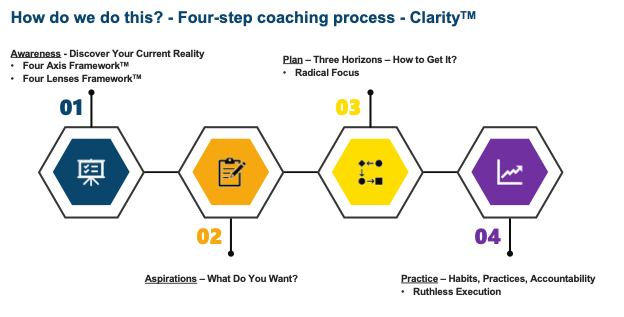
Stage 1: Awareness We discover your current reality and challenges: What is reality for you right now? This is the phase in which we get to know each other and figure out what is going on for you. This lays the groundwork for the success of the engagement. We use the Four AxisTM and the Four LensesTM frameworks to assess what has worked for you and what has not.
Stage 2: Aspirations We establish your goals: What is most important to you and why do you want to work on it now? We will establish 3 primary and secondary coaching goals, set strategies that break those goals into practical and achievable stages along goals into practical and achievable stages along the coaching journey, and lastly actions. The goals, strategies, actions framework is an excellent approach for bringing about a rich journey of discovery, learning and growth.
Stage 3: Plan We build your plan: The methodology we will be using is iterative. In stage 1 and 2, key elements emerge and in stage 3 we solidify the plan around your key goals. We gain clarity about the future you are reaching for, the changes you are committed to make and the link between those changes and the impact to your environment. We will identify essential steps that bring lasting, sustainable, and transformational change. We will identify your strengths to build upon; identify obstacles or “boulders” holding you back and address them; we will do some “inner work”, to increase your self-awareness; and will do some “outer work” to practice and build new behaviors and “habits”. All of that will become the plan you will be working from.
Stage 4: ExecuteWe execute your plan: We focus on “practice” - the steps you make every day and week to learn or unlearn habits and build new muscle in executing the actions that make up your plan. We will leave room for recalibrating the goals as your progress unfolds. This might be a time when we want to check in with friends, family, and other stakeholders. We will decide this during our engagement.
•After six-twelve months, we step back and examine our effectiveness and the impact the engagement has had on you. If you wish to continue the relationship, we can renew the contract for another six or twelve months. You can continue to count on my follow up and future support as requested.
•A typical coaching relationship will last a year to two years, with some lasting much longer. Genuine change and improvement require patience, consistent and persistent effort, especially concerning leadership habits and mindsets. It's important to understand that success requires cultivating enduring behavioral shifts rather than seeking quick fixes, and such meaningful evolution takes time.
Leaders will work on a variety of topics during executive coaching sessions. The exact focus depends on the individual leader's needs, challenges, and aspirations. The topics listed below represent a snapshot of the myriads of areas leaders might explore in executive coaching.
- Career Transitions: Navigating role changes, promotions, or shifts in career paths.
- Strategic Thinking: Enhancing the ability to envision, plan, and execute long-term goals.
- Team Building & Management: Developing the skills to create, lead, and motivate high-performing teams.
- Time Management & Productivity: Finding ways to manage time effectively and enhance personal and team productivity.
- Decision-Making: Honing the ability to make informed, timely, and confident decisions.
- Delegation: Understanding when and how to delegate tasks effectively to empower team members.
- Leadership Presence: Enhancing their ability to command a room, inspire teams, and exude confidence.
- Emotional Intelligence: Understanding and managing one's own emotions while effectively interacting with others.
- Communication Skills: Improving verbal, non-verbal, and written communication, particularly in high-stakes or sensitive situations.
- Conflict Resolution: Acquiring techniques to address and mediate conflicts constructively.
- Change Management: Leading teams through organizational changes or industry shifts.
- Work-Life Balance: Finding equilibrium between professional responsibilities and personal life.
- Feedback & Performance Reviews: Giving and receiving feedback constructively.
- Cultural Competency: Leading diverse teams and understanding cultural nuances.
- Succession Planning: Preparing for future leadership roles and ensuring organizational continuity.
- Professional Development: Identifying areas of growth and pursuing relevant training or education.
If You are Interested to Pursue Our Coaching Journey Together
Let's move to the next step. For details on 'how', fill out a brief contact form letting me know you would like to engage.
Contact Me
Have a question or thought to share? Want to sign up to my mailing list for future events and offers? I'd love to hear from you.